
UltraVoice and 250 Years of American Independence
There’s something fitting about a company dedicated to giving people their voice back being born in Philadelphia, the city where the loudest declaration in American history was first read aloud.
This year, as the United States marks 250 years since the signing of the Declaration of Independence, we’re taking a moment to reflect on our own, much smaller chapter of Philadelphia history, and why this city has always been the right place to fight for someone’s right to be heard.
Where It All Started: April 1990
In April of 1990, a young scientist named David Baraff, PhD, arrived in Philadelphia with an unusual mission. A New Jersey native, Dave had trained at Princeton and the University of Chicago before spending several years at Bell Labs of Canada, the kind of resume built for cutting-edge research, not necessarily for inventing a wearable medical device.
But Dave wasn’t interested in incremental work. He wanted to solve a problem that had quietly affected people for generations: how do you help someone who has lost their larynx speak again, in real time, without surgery or an external mechanical buzz?
The opportunity found him at Thomas Jefferson University. Jefferson’s technology transfer office held a patent for an early-stage concept in voice restoration, and they needed someone willing to take a raw, unproven idea and turn it into something a laryngectomee could actually use. The prototype was, by Dave’s own account, far from ready. It was promising in theory, but nowhere close to commercially viable.
So began years of painstaking refinement. Dave’s goal was simple to state and enormously difficult to achieve: build a non-invasive, wearable alternative to esophageal speech and the electrolarynx, something that gave laryngectomees a third option for getting their voice back.
Out of that work, UltraVoice was born.
A City Built on the Idea That Every Voice Matters
It’s worth remembering, especially this Independence Day, what Philadelphia was doing 250 years ago.
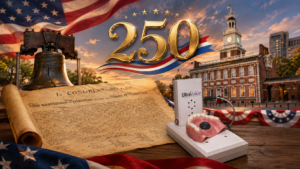
This is the city where Thomas Jefferson drafted the words that would define a nation, and where, in July of 1776, the Declaration of Independence was adopted and first read publicly to a crowd outside what we now call Independence Hall. It’s the city where the Liberty Bell, inscribed with the words “Proclaim Liberty Throughout All the Land Unto All the Inhabitants Thereof,” rang out as a symbol of a people’s right to speak for themselves and govern themselves.
A few blocks away, Benjamin Franklin was busy founding institutions that would shape American civic and scientific life for centuries.
Philadelphia, in other words, has always been a city obsessed with one idea: that having a voice, and being able to use it, is fundamental to human dignity.
It’s not a stretch to say that same spirit shaped what Dave set out to do at Jefferson in the late ’80s and early ’90s. Laryngectomees don’t lose their thoughts, their wit, or their relationships when they lose their larynx. They lose the mechanism for expressing them. UltraVoice exists because that mechanism matters, and because every person deserves the tools to be heard on their own terms.
36 Years Later: Still Refining, Still Listening
Thirty-six years after Dave first arrived in Philadelphia, UltraVoice is still doing exactly what it set out to do, just better, smaller, and smarter.
This year feels like a particularly big one, and not just because of the anniversary on the calendar. We’re partnering directly with laryngectomees and speech-language pathologists (SLPs) to push the technology forward in ways that matter most to the people who use it every day. We’re developing smaller batteries that make the oral unit more comfortable to wear throughout the day, and smarter signal processing software designed to help patients sound more like themselves and be more intelligible to the people they’re talking to.
We’ve also brought on an embedded systems engineer from the University of Pennsylvania’s AI and Machine Learning lab to help us adapt our signal processing model for real-time speech detection and augmentation. This work is still under investigation, but we’re optimistic about where it’s heading. The long-term goal is a personalized neural net that can learn an individual patient’s unique anatomy, voice, and dialect, because no two laryngectomees sound the same, and no two solutions should either.
Proclaiming Liberty, One Voice at a Time
Two hundred fifty years ago, Philadelphia was the site of a radical idea: that people have the right to speak for themselves. Thirty-six years ago, that same city became the starting point for a much quieter, but no less meaningful, mission to make sure that right doesn’t disappear just because someone has undergone a laryngectomy.
UltraVoice is proud to carry that mission forward, in the city where it began, in the year America turns 250.
Want to learn more or get involved? Contact us through our website.