
Voice Banking Before Laryngectomy: A New Step in Preparing for Surgery
Every year, roughly 185,000 people worldwide are diagnosed with laryngeal cancer (Ahmadi, as cited in Create Digital, 2022). For many of them, a total laryngectomy surgery will be part of their treatment plan. Alongside the medical preparations, rehabilitation planning, and conversations with care teams that naturally accompany this process, there is a newer step that more patients and clinicians are begi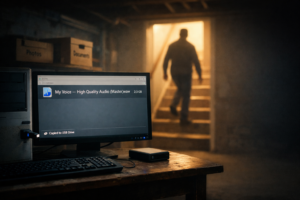 nning to incorporate: voice banking. Thanks to recent advances in artificial intelligence, it is now possible to create a high-fidelity digital clone of a person’s voice from audio recordings — and that clone can be used with a speech aid device or app to communicate in a voice that sounds remarkably like the original. For patients preparing for a complete laryngectomy, recording their voice before surgery is becoming a practical and increasingly standard part of the preparation process.
The technology behind voice cloning has improved significantly in recent years. Companies like ElevenLabs — which has partnered with the laryngectomy advocacy organization Lary’s Speakeasy to offer free professional voice cloning accounts to qualifying patients (Lary’s Speakeasy, 2025) — can build a digital replica of a person’s voice from as little as a few minutes of clear audio, though one to three hours of diverse, high-quality recordings produces the most natural results (ElevenLabs, 2025a). The system analyzes vocal features such as pitch, cadence, inflection, and emotional tone, then trains a neural network to reproduce those patterns on demand. The results go well beyond the flat, robotic text-to-speech of a decade ago; modern voice clones capture warmth, rhythm, and personality. When ElevenLabs recreated Congresswoman Jennifer Wexton’s voice from archived floor speeches after a neurological disorder affected her ability to speak, she was able to deliver what is believed to be the first AI-cloned voice address on the House floor (PBS News, 2024). ElevenLabs is not alone in this space. Respeecher, a voice synthesis company with roots in film and media, has been collaborating with laryngectomy researchers to transform the mechanical sound of electrolarynx and tracheoesophageal prosthesis speech into clearer, more natural audio — and has demonstrated the ability to rebuild a patient’s pre-surgery voice using banked recordings (Respeecher, 2025a). In one collaboration, researcher and laryngectomee Konrad Zieliński worked with Respeecher to convert his electrolarynx speech into a voice closely resembling his pre-surgical voice, using recordings made four years earlier (Respeecher, 2025b). For patients who use a voice machine for throat communication or any electronic speaking device after surgery, these platforms offer a meaningful improvement in communication quality. The key, of course, is having voice recordings made before surgery — the raw material from which AI builds the clone.
What makes voice banking especially worthwhile right now is not only what AI can do today, but where the technology is headed. Currently, a cloned voice can read typed text aloud through a speaking tablet or phone app, which is already a valuable tool for daily communication. The next frontier, however, is real-time transcription and voice conversion — technology that would listen to the sound produced by an artificial voice box or other speech impaired devices, interpret the words, and re-voice them in the patient’s own cloned voice, all in real time. Rather than typing a sentence and waiting for it to be spoken, a patient could simply talk through a speech machine for disabled speakers and have their own voice come through naturally on the other end. Teams are already working on this challenge, developing alaryngeal speech-to-text software specifically trained on the acoustic patterns of electrolarynx and intraoral device users, including those who use the UltraVoice system (UltraVoice, 2025). The technical hurdles are well understood: alaryngeal speech lacks the natural pitch cues that standard recognition models rely on, device hum introduces interference, and latency must remain low enough to feel conversational (UltraVoice, 2025). Academic researchers are also making progress, advancing electrolaryngeal speech enhancement through neural networks and voice conversion methods that improve both naturalness and intelligibility (Liu et al., 2022). The technology is not yet turnkey, but the trajectory is promising — and patients who have banked their voice will be well-positioned to benefit as these tools mature.
Beyond AI voice cloning and real-time transcription, there is another practical way that pre-surgery voice recordings can benefit patients right now. Companies like UltraVoice are developing companion software for their speech generating devices that takes a different approach from full AI voice recreation. Rather than attempting to digitally replicate every quality of a person’s voice, the UltraVoice programmer software analyzes audio samples from a patient’s past recordings to identify the characteristic frequency range of their natural speaking voice. This is not artificial intelligence reconstructing a voice from scratch — it is targeted calibration, ensuring that the speech aid device generates tones that sound more familiar to the patient and the people around them. The distinction matters because it represents something patients can benefit from immediately, without waiting for real-time AI transcription to reach full maturity. A speech generating device tuned to a patient’s pre-surgical voice can make everyday conversation feel more natural, even through a device. It is one more reason that recording high-quality audio before surgery has practical value: those same recordings can serve both as source material for future AI cloning and as calibration input for device programming today.
For ENT surgeons and head-and-neck oncologists, voice banking fits naturally into the broader conversation about post-surgical voice rehabilitation. That discussion has traditionally centered on the three established methods: tracheoesophageal puncture with voice prosthesis, esophageal speech, and the electrolarynx (Brook, 2017). Each has well-documented strengths and trade-offs, and considerations like artificial voice box price and ongoing maintenance remain relevant for many patients. Voice banking adds a complementary step — not a replacement for any of those options, but a low-cost, low-risk action that can be taken during the pre-operative window. The recording process is straightforward: a quality USB microphone in a quiet room can produce audio suitable for professional-grade cloning (ElevenLabs, 2025a). Patients are encouraged to record in a natural, consistent speaking style, capture a range of sentences and conversational tones, and aim for at least thirty minutes of clean audio — ideally more. Surgeons and speech-language pathologists can introduce this option alongside other preparation steps, helping patients understand what is available now and what may become available in the coming years. It is equally helpful to set clear expectations: real-time voice-to-voice conversion for in-person conversation is still in development, and patients should approach vendor claims with informed skepticism (Lary’s Speakeasy, 2024). That said, the text-to-speech applications available today are already making a real difference. Sonya Sotinsky, who underwent a total glossectomy and laryngectomy for oral cancer, banked her voice before surgery and later worked with AI cloning technology — her daughter described the result as so close to the original that the whole family was moved to tears when they first heard it (NPR, 2025).
The laryngectomy community has a long history of adapting and finding new ways to communicate. From the earliest external electrolarynx devices to today’s intraoral speech generating devices like the UltraVoice speaking device, each generation of assistive technology has brought patients closer to natural conversation (Takahashi et al., 2005). AI voice cloning is the next step in that progression, and it is one that patients and caregivers can take advantage of today simply by setting aside some time with a microphone. For those who have already undergone surgery without banking their voice, the outlook is still positive: companies like Respeecher have demonstrated that post-surgical electrolarynx speech can be enhanced and converted to sound more natural, and the underlying algorithms continue to improve (Respeecher, 2025a). For anyone preparing for a laryngectomy, voice banking is becoming a routine part of getting ready — like any other item on the pre-surgery checklist. A few hours of recording now can open doors to communication tools that are improving every year. It is a small investment of time with the potential to make a lasting difference.
References
Brook, I. (2017). The electrolarynx: Voice restoration after total laryngectomy. PMC. https://pmc.ncbi.nlm.nih.gov/articles/PMC5484568/
Create Digital. (2022, April 13). AI enables laryngectomy patients to get their voice back. Engineers Australia. https://createdigital.org.au/ai-enables-laryngectomy-patients-to-get-their-voice-back/
ElevenLabs. (2025a). Voice cloning overview. ElevenLabs Documentation. https://elevenlabs.io/docs/creative-platform/voices/voice-cloning
ElevenLabs. (2025b). ElevenLabs Impact Program. https://elevenlabs.io/impact-program
Lary’s Speakeasy. (2024, February 20). Voice cloning for the laryngectomee community. https://larysspeakeasy.org/voice-to-voice-cloning-for-the-laryngectomee-community-not-quite-there-but-close/
Lary’s Speakeasy. (2025). Voice cloning. https://larysspeakeasy.org/voice-cloning/
Liu, H., Hu, Q., Zhang, L., Huang, Z., & Xu, L. (2022). Electrolaryngeal speech enhancement based on a two stage framework with bottleneck feature refinement and voice conversion. Biomedical Signal Processing and Control, 80, 104339. https://doi.org/10.1016/j.bspc.2022.104339
NPR. (2025, July 22). She couldn’t speak after cancer, but found her voice through AI. Shots — Health News. https://www.npr.org/sections/shots-health-news/2025/07/22/nx-s1-5464154/oral-cancer-laryngectomy-glossectomy-ai-voice-text-to-speech
PBS News. (2024, July 25). A neurological disorder took Rep. Jennifer Wexton’s voice. AI helped her bring it back to the House floor. https://www.pbs.org/newshour/politics/a-neurological-disorder-took-rep-jennifer-wextons-voice-ai-helped-her-bring-it-back-to-the-house-floor
Respeecher. (2025a). Respeecher’s voice synthesis: Restoring natural speech for laryngectomy patients. https://www.respeecher.com/case-studies/respeecher-helps-patients-speech-disabilities-recover-voice
Respeecher. (2025b). Advancing voice restoration: Respeecher’s collaboration with researcher Konrad Zieliński. https://www.respeecher.com/case-studies/respeecher-collaborates-researcher-advance-voice-capabilities-laryngectomy-patients
Takahashi, H., Nakao, M., Kikuchi, Y., & Kaga, K. (2005). Alaryngeal speech aid using an intra-oral electrolarynx and a miniature fingertip switch. Auris Nasus Larynx, 32(2), 157–162. https://doi.org/10.1016/j.anl.2005.01.007
UltraVoice. (2025, December 16). The hidden challenges of speech-to-text for laryngectomees. https://www.ultravoice2.com/the-hidden-challenges-of-speech-to-text-for-laryngectomees/