
The Hidden Challenges of Speech-to-Text for Laryngectomees
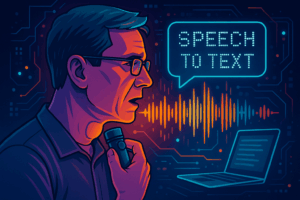
Speech-to-text has changed how millions of people communicate. From voice assistants to live captioning, it can feel like converting speech into text is a solved problem. But for people using alaryngeal speech after a laryngectomy, the challenge is fundamentally different. Whether someone speaks with an electrolarynx (often searched as an electronic voice box, electric voice box, or electronic voice box machine) or another voice box device, the sound source and signal quality are not what mainstream speech models were built for. Our team has been developing specialized alaryngeal speech-to-text software, and we have learned that many “normal” speech-recognition hurdles show up here too, just amplified by the realities of life after laryngectomy. Understanding these challenges helps explain why progress is real, but also why it requires patience and precision.
1. Real-world audio is messy
In a lab, microphones capture clean sound. In the real world, they capture everything. Homes, clinics, restaurants, cars, and crowded rooms introduce background noise: HVAC hum, dishes clinking, traffic, TVs, and overlapping voices. Even with advanced filtering, that noise can blend into the speech signal and confuse recognition systems. Noise reduction helps, but it is never free. Every attempt to remove background sound risks removing part of the user’s voice signal too. The result is a constant tradeoff between clarity and distortion.
2. Alaryngeal speech is difficult, even for humans
Unlike typical vocal speech, alaryngeal speech does not come from vocal cords. That means it can lack the natural pitch and tonal cues that listeners unconsciously rely on. Even trained human listeners may hear ambiguity, where one sound could match multiple possible words. Humans use context to “fill in” missing detail. Software has to do the same, but with statistical models rather than intuition, and models are usually trained on typical laryngeal speech, not the patterns produced by an artificial voice box or other post-laryngectomy speech methods.
3. Latency is not just technical, it is emotional
Speech-to-text is rarely instantaneous. Audio is captured in short segments (chunks), processed, then turned into text, and sometimes into a synthetic voice output. That creates delay, often most noticeable right at the start of a sentence. When output lags behind lip movement or intent, it can feel disorienting. Many people have experienced a milder version of this when hearing their own voice delayed through a speaker system. For laryngectomees relying on assistive technology, that timing mismatch can disrupt rhythm, reduce fluency, and chip away at confidence.
4. Post-laryngectomy realities add extra signal “events”
There are also practical, human factors that typical speech datasets do not include enough of. For example, after laryngectomy, some people may cough unexpectedly, clear the stoma, or experience moments where they aspirate after laryngectomy (food or liquid going the wrong way). Those sounds and interruptions can enter the microphone stream and look like speech to an algorithm, especially if the system is trying to respond quickly in real time. A robust system has to detect these events, avoid “hallucinating” words, and recover gracefully without making the user feel like they broke the technology.
5. Raw sound conversion vs language understanding
There are two common technical paths, and each has real tradeoffs:
A) Speech-to-text-to-speech The system recognizes words first, then speaks them using a synthetic voice (what many people mean when they search “synthetic voicebox”). The upside is clarity and language-level correction. The downside is added processing time, especially if the system applies context “auditing” (similar to autocorrect).
B) Speech-to-speech This approach tries to convert sound patterns directly into more speech-like audio, potentially with very low latency and on-device processing. The limitation is accuracy, because alaryngeal speech often contains less acoustic detail than typical vocal speech. Neither approach is “the” answer. Practical solutions often blend ideas from both.
6. Why this problem is worth solving?
Speech-to-text for laryngectomees sits at the intersection of acoustics, real-time computing, linguistics, and human psychology. Progress does not come from one breakthrough. It comes from many small improvements: better microphones, smarter noise filtering, models trained on alaryngeal speech, faster on-device processing, and language systems that correct errors without adding frustrating delay. For the laryngectomy community, this is not just about engineering. It is about restoring autonomy, dignity, and effortless everyday communication, whether someone uses an electrolarynx, a voice box, or another “larynx voice box machine” style solution people search for online. And that is why every millisecond of latency and every percentage point of accuracy matters.