
Stranger Things and the Reality of Communication without a Voice Box
(Minor Spoiler Alert)
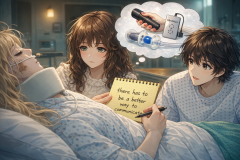
Television often uses silence as a storytelling tool. In Stranger Things Season 5, Episode 2, one quiet but unsettling moment stands out when Mrs. Wheeler suffers an injury to her larynx. Suddenly unable to speak, she turns to writing words on paper to communicate as tension builds around her. For viewers, the silence heightens suspense. Each pause feels loaded. Every written word matters. But for tens of thousands of Americans, this silence is not a dramatic device. It is daily life. For people who have undergone a laryngectomy or experienced permanent injury to the larynx, losing one’s voice is not temporary or neatly resolved in the next episode. It is a profound and lasting change that affects communication, relationships, independence, and identity.
Handwriting to Communicate Builds Drama on Screen. In Real Life, It Can Be Exhausting.
In Stranger Things, writing replaces speech in a way that feels intense and cinematic. The audience leans in, waiting for the message to appear. In real life, relying on written communication is often frustrating, slow, and isolating for both the communicator and the person trying to understand them. Writing interrupts the natural rhythm of conversation. It removes tone, spontaneity, and emotional nuance. Everyday interactions like ordering food, answering a question, or reacting in real time suddenly require extra effort and patience. For many laryngectomees, the frustration is not just about being understood. It is about no longer being heard in the way they once were. Families and caregivers feel this shift as well. Conversations that were once fluid become careful and delayed. Emotional moments can feel muted when they must be written instead of spoken. What looks manageable from the outside can feel deeply limiting from within.
Speech Is More Than Sound
Speech is not simply a way to transmit information. It is central to human connection. It allows people to interrupt, laugh, express urgency, comfort others, and participate fully in group settings. Losing the ability to speak often feels like losing a part of one’s identity, not because the person has changed, but because the world responds to them differently. Speech-language pathologists see this reality every day. So do spouses, children, and caregivers supporting someone who can no longer use their natural voice. The brief silence shown in Stranger Things reflects a long-term reality for an estimated 30,000 to 50,000 laryngectomees in the United States, with roughly 3,000 new laryngectomies performed each year.
Life After Laryngectomy: Communication Options
After a laryngectomy or permanent laryngeal injury, individuals are typically introduced to several speech options, each with benefits and tradeoffs. Some people pursue esophageal speech, which can require extensive training and practice. Others use electrolarynx devices, which restore sound but require hand use and often produce a mechanical voice quality. Tracheoesophageal puncture, or TEP speech, can be effective for some, but it involves additional surgery, routine maintenance, and ongoing medical care. Not every option works for every person. Individual anatomy, lifestyle, comfort, and personal goals all matter.
A Non-Invasive, Hands-Free Alternative
UltraVoice was developed to help address some of the everyday frustrations associated with communication after laryngectomy. UltraVoice is a non-invasive, hands-free, custom-fit speech solution designed for people who have had a laryngectomy or permanent injury to the larynx. It is embedded into a custom oral appliance and does not require additional surgery. Because each device is custom-fit, it is designed to work with the individual’s anatomy and dental structure. Many users value the ability to communicate without holding a device or interrupting daily activities. For families, hands-free speech can restore more natural conversation. For speech-language pathologists, UltraVoice can serve as another tool to support communication goals related to independence, clarity, and quality of life.
Restoring Conversation, Not Just Sound
Scenes like Mrs. Wheeler’s remind us that the absence of speech is felt most deeply in ordinary moments. When someone wants to respond quickly. When they want to express emotion in real time. When they want to comfort a loved one or speak up in a group. Writing can communicate words, but it cannot fully replace participation in spoken conversation. While no technology can perfectly replicate a natural voice, solutions like UltraVoice aim to restore something equally important: the ability to engage, respond, and connect without delay.
From Screen Silence to Real-World Possibility
Mrs. Wheeler’s injury in Stranger Things may evolve as the story continues. For many people living after laryngectomy, the journey is ongoing. Silence does not have to be the end of the story. With the support of speech-language pathologists, caregivers, and evolving technology, people who have lost their larynx can continue to communicate and connect without relying solely on pen and paper. Because while silence may heighten suspense on screen, in real life, restoring a voice restores something far more powerful: human connection.
Minor spoiler alert: This post references a non-plot-critical communication challenge depicted in Season 5, Episode 2 of Stranger Things.